
4 Tips to Help Your New Year’s Goals Really Stick

Wow, the holiday season really flew by, didn’t it? There is so much anticipation leading up to Christmas, and in one wonderful, joy-filled day with family, it’s over. The lights come down, the Christmas music goes away, and life returns to normal. Couldn’t it last just a little longer?

I know I’m not the only one who experiences a post-holiday funk from time to time. But, I’ve found the best antidote is having new things to look forward to. When I take a fresh start to the new year with a sense of purpose and adventure, it makes all the difference in the world. It involves setting new goals to better myself and exploring new ways to contribute to things I’m passionate about! There’s a LOT to look forward to when we take a strategic approach.

So, in this season of new hopes and resolutions, here are a few tips to make your 2015 goals really stick and take your life to a whole new level:

  1. Set tangible goals, not generic For example, saying “I want to become more philanthropic and outward-focused in the coming year,” doesn’t give you something tangible to work towards. Instead, make a more specific resolution, such as “I would like to start volunteering at the soup kitchen once a month and donating 5% of my income to my favorite charity/mission.” See the difference? Measurability improves accountability!
  2. Be realistic. Don’t tell yourself you’d like to buy a new Mercedes if you can’t afford it, or hope you’ll lose 50 pounds if you don’t have time to go to the gym or plan to drastically change your diet. Instead, resolve to buy a safer vehicle with less than thirty thousand miles on it, or to exercising daily and eat healthier. Success with small steps builds momentum!
  3. Involve a friend. If you’re hoping for big change in your life but you’re in it alone, it’ll be much more difficult. With the buddy system, you’ll have accountability and someone to keep you on track (and you can do the same for them). Encouragement builds hope and confidence! Plus, it’s a lot more fun!
  4. Give yourself grace. Above all else, be kind to yourself. No one is perfect, and even a small upward movement is better than no movement at all. If you made a mistake and did something you swore you wouldn’t do last year, IT’S OKAY. Tomorrow is a new day, with new opportunities for growth and impact. More often than not, achieving our goals is a “two steps forward, one step back” reality. So, don’t get discouraged when you regress a little. Shake it off, resolve to get back on track today, and remember, you’ve got this!

So, have at it! As you put away your holiday gifts and decorations, start thinking about what you can do to make 2015 really count for you, your family, and your friends. Instead of feeling disappointed that the season is over, be filled with anticipation for what is to come. It’s never too late to make an effort to better yourself, and this is the perfect time to do it. Good luck!

The Two Stages of Life and What Really Matters

“What do you want for Christmas?” is probably the most asked question right before the holidays. You’ve probably been asked, and even asked it yourself, more times than you can count over the last couple weeks. Sure there was a time in my life that my list was a mile long, but things change. Now, my Christmas list is filled with hopes for others—especially the young people in our communities.

It’s said that the first half of one’s life is the “accumulation stage” and the second half is the “distribution stage.” During the accumulation stage, you’re in gathering mode, spending your efforts on life’s needs and wants.  You build a career, buy and furnish a house, start a family and buy the things necessary for your children, save for retirement, and buy lots of things along the way. Many of us could probably go in our closets or garages and pull out items we haven’t touched in years, or forgot we had! But is that all there is to life?

But then, one day, around the age of 50, it hits you. You have all the toys you need, your kids’ braces are paid for and they’re in college or beyond. You have a boat and a new deck and a comfortable car. You discover that the joy of giving is greater than the joy of receiving, and your perspective changes dramatically. I’m a typical case—it happened to me around 49! That’s when my life focus really shifted to helping children and young adults lay a solid leadership foundation for life. Pursuing my passion of equipping young people to succeed in the real world has been more fulfilling than anything I could have imagined.

Did you notice how the first half of life tends to be more skewed toward self and family, and the second half is more focused on others? Had I known this earlier, I would have sought more balance in my accumulation stage and started my distribution stage sooner. The joy and satisfaction that comes from giving our time, talent, and treasure so far outweighs the fun of accumulating that I regret not starting this process earlier.

With Christmas just a few days away, opportunities for giving and sharing abound. This is the easiest time of year to find ways to positively impact others and give of our excess. But hopefully, directing our lives toward others will not be a once-a-year event. By starting earlier and making it last the whole year long, we receive far more in return than we will give. So, where is your heart and passion leading you today?

Do you want your life to have more balance, your spirit to soar, your heart to be filled with joy, and your life impact to be maximized—all while making the world a better place? Embrace the gift of giving yourself this holiday season and see where it takes you. Then, make it the gift that keeps on giving, into January, the New Year, and beyond.  Next time you hear “what do you want for Christmas,” do a self-check. Let’s all make the resolution to begin our distribution stage earlier and put an end to accumulating stuff we’ll rarely use and may even forget about!

Take a few seconds to reflect: Where are you centering your life? How are you modeling this principle to the young people in your life? Have you begun the distribution stage? Share your insights and ideas with us; we’d love to hear from you!

Why YOU Need an Emergency Savings Fund

Sometimes the unexpected happens. You lose your job. You have to take a pay cut when your employer faces a business downturn. Your car just died. You just got in a wreck and will be out of work for months. Your roof leaked (or, in our case, our septic system backed up!) while you were on a long vacation. What will you do?

Hopefully you’ve planned for emergencies.

According to a 2011 survey by the National Foundation for Credit Counseling, 64% of Americans don’t have enough cash on-hand to handle a $1,000 emergency. This means that if a crisis strikes, big or small, and you DON’T have money put away for emergencies—you could be in for some real stress and heartache.

An “emergency fund” is an account set aside with money earmarked solely for high impact situations that could substantially affect your wellbeing or quality of life. As a rule of thumb, a fund that contains four to six months worth of average monthly expenses (invested in safe, short-term investments) will help serve as a buffer in these unfortunate situations. During periods when the economy is weak and your job may be in jeopardy, it’s sensible to build a six to twelve-month emergency to give you an extra cushion. Establishing an emergency fund should be your first financial priority once you begin your career.

To determine how much you should have in your emergency fund, you should first identify what constitutes six months’ worth of expenses for you. Add up what you spend each month on normal household budget items and multiply by six. Make sure you include what you pay for your mortgage, utilities, loans, insurance, gas, groceries, and other essential expenses, allowing a small amount for incidentals and entertainment, etc.

Then, to avoid being tempted to spend the money you need to use to build your emergency fund, it may be helpful to set up automatic account transfers (or automatic deposits from your paycheck if your employer offers this). You’ll also need to be disciplined and NOT give into the temptation to withdraw from your emergency fund for vacations, high tech toys you think you can’t live without, or for any other non-emergency expenses or indulgences.

Ultimately, what an emergency fund buys you is peace of mind. If something comes up, you won’t have to scramble to come up with the money you need and you won’t have to turn to credit cards or other debt. It’s like an insurance policy that you’ll be glad you have when life throws you a big fat lemon!

How have you created an emergency fund? It’s never to soon or too late to start. Share your ideas, experiences, and questions with our online community; we’d be glad to hear from you. And pass our site along to a friend and suggest they subscribe; they might be thankful for it!

4 Tips to Help You Learn from Your Defeats

In recent years I’ve had the great privilege of visiting an alternative high school that serves the neediest and most challenged of students. One particular encounter with a high school  principal—a man who had given his life to reach and impact disadvantaged youth—left me inspired and encouraged. His stories of the ups and downs of working with that student population reminded me of the unforgettable introduction to “ABC’s Wide World of Sports,” when the narrator would dramatically announce, “…the thrill of VICTORY and the agony of DEFEAT.” Seeing a homeless student with a violent gang background graduate from high school—victory! Seeing another go back to the streets—defeat.

No matter where our life path takes us, we’ll experience victories and defeats. Whether it’s sports, contests, career, dating, education, or business ventures, you win some and you lose some. Most of us don’t have too much difficulty with the winning part.

But sometimes, we don’t win. But does this mean that we’ve technically lost? No!  Many of our “losses” prepare us for our victories later on. They can be a major stepping stone—that is, if we choose to learn from our defeats.

Vince Lombardi of Green Bay Packer fame used to say that winning “is the only thing.” Famed basketball coach John Wooden, on the other hand, simply asked his players to play their best, and that was good enough for him. Although he set a very high bar for his players, he was more process driven than outcome driven.

I’m probably more in John Wooden’s camp (despite growing up 20 miles from Green Bay!). Winning may be an important goal, but I don’t believe we’re losers if we don’t finish in first. The key is to learn from a defeat and use it as input for the next practice and for future strategy.  Want a couple tips for making this happen, just in case? Try these:

  1. Don’t see a defeat as an “end all.” In most cases, it’s not the end of the road. Always be on the lookout for new opportunities, new relationships, etc. Something better may be around the corner! Consider if it’s a teachable moment and a catalyst for personal growth. As Helen Keller said, “A bend in the road is not the end of the road…unless you fail to make the turn.”
  2. Be willing to step out of your comfort zone. Change is not always a bad thing.
  3. Accept that you are not always right and you won’t always have the best strategy. Seek out advice and perspective from others.
  4. Approach situations with the mindset that you’re going to give it your all. You can’t be dissatisfied when you’ve done your very best!

It pays to humbly celebrate your victories and gain and grow from your defeats. You’ll be positioned you to do better the next time (perhaps with a better outcome!), and it will take some of the sting out of your losses! Helen Keller had a great perspective.

How have you handled your victories and losses? Do you view a short-term loss as a learning experience?? Are you satisfied with the outcome if you did your best?

10 Tips to Help You Master Your Time

Wow, where has the time gone? It seems like just yesterday when we toasted the new millennium, but here we are, about to ring in 2015. Sure, it’s a cliché phrase, but time really does fly by.

Time’s a funny thing, isn’t it? When we’re having a blast, it feels like someone is pushing the “fast forward” button. In contrast, if we have a two-point lead with three minutes left in the game, it feels like an eternity. When we’re suffering through a valley, we can’t wait for time to pass by.

Whether time flies or moves at glacial speed, we still have 24 hours in a day, seven days in a week, and no choice in the matter. We use it or lose it. And, because time is one of our most prized possessions, we need to use it wisely.

How can you become a good manager your of time?

Simply practice these tips:

  • Treat your time as a precious asset with limited capacity (this mindset is huge!)
  • Organize a to-do list by urgency (deadline) and priority (importance). Take both into account when deciding what to focus on each day.
  •  “Block” your time (i.e., group it in 30-60 minute intervals without interruption) in order to complete your highest priority assignments. Avoid interspersing lower priority tasks within your high priority assignment intervals. Take control!
  • Don’t hesitate to politely tell someone that it’s an inconvenient time for you. Interruptions can destroy your productivity if you allow it. Always saying “yes” is not necessarily a good thing!
  • Learn to multi-task your lower priority responsibilities. For example, I rarely watch television without doing something else like reading the newspaper or responding to emails.
  • Keep your cell phone somewhere else when you need focused time. The temptation to answer calls and texts is a major distraction. Smart phones can be our worst enemy if we aren’t careful.
  • Find your best venue for focused work. Is it your home office? A coffee shop? Your patio?
  • Take periodic breaks. Studies show we’re less productive when we work over an hour straight without a five-minute break. Breaks help our mind recharge.
  • Respect and honor the time of others by being punctual. You’d want them to respect your time, too.
  • Always remember that you can’t recover the time you waste!

The older we get, the quicker time flies by. Regardless of our stage in life, it’s never too late to improve your time management skills and resources. Becoming a wise time manager is an admirable New Year’s Resolution. Is it yours?

How productive are you with your time? Do you view it as a precious asset and focus on your most important priorities? What are some ways you have learned to become a more effective time manager?

Celebrate the Season! Annual LifeSmart Book Sale!

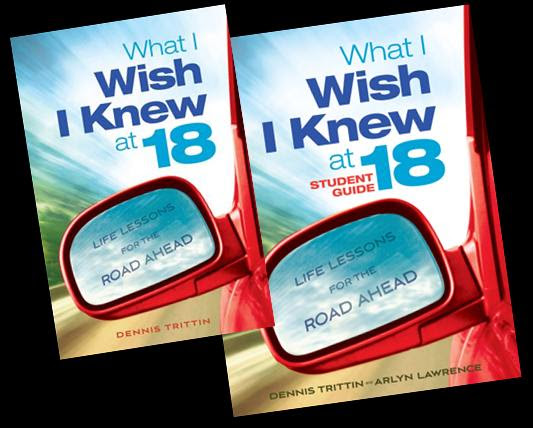
It’s been a great year at LifeSmart! We are filled with gratitude as What I Wish I Knew at 18 continues to impact the lives of young adults globally, and our newest book, Parenting for the Launch: Raising Teens to Succeed in the Real World, receives rave reviews for encouraging and equipping parents (click here for more information).

We think it’s time to CELEBRATE!
Our 4th annual Cybersale is offering Parenting for the Launch and ourWhat I Wish I Knew at 18 book and guides at substantial savings, just in time for holiday gift-giving and classroom orders for the New Year:
What I Wish I Knew at 18 BOOK – $14.99
What I Wish I Knew at 18 STANDARD STUDENT GUIDE – $14.99
What I Wish I Knew at 18 CHRISTIAN STUDENT GUIDE – $14.99
Parenting for the Launch – $14.99
(further bulk discounts available!)
now through Christmas
Order at AtlasBooks.com or 1-800-BOOKLOG
and use the Promo Code: CHEER
Parenting for the Launch serves as a wonderful gift for parents while What I Wish I Knew at 18 is a special keepsake gift or stocking stuffer for:
·teens and young adults
·parents and caregivers
·mentors and coaches
·teachers and faith leaders
·clients who are raising families
It’s our way of saying “Thanks!” for your support—and to wish you a joy-filled holiday season!
Blessings,
The LifeSmart Team.

How to Be an MVP Employee — A Lifesmart DVD

Are the young people under your supervision—children, students, or employees—prepared to soar in their eventual career? Not just to land the job, but to be a workplace MVP?
With high youth unemployment and all-consuming scholastics and activities driving their schedules and priorities, many of today’s young adults are entering the work force sorely lacking the skills and maturity they need to thrive in the real world.
We hear from employers all the time: “They may be book smart, but they’re certainly not life smart,” or, “They can write a resume and complete an application, but they lack the intrinsic qualities and life skills we need in our employees.” Many students understand how to succeed in the “front end” (resume and interview skills), but aren’t trained to succeed once they land the job.
At LifeSmart, we’re excited to announce our newest resource designed to help create future workplace superstars!
offers invaluable perspectives from employers and four road-tested strategies for succeeding in any career:
Selecting a career that plays to their natural strengths and interests
Modeling the qualities employers value
Delivering on-the-job excellence
Contributing to their employer’s success
This 45-minute live presentation at Appleton West High School includes illustrations, skits, training, and strategic insights to promote career readiness and workplace excellence. Viewers will gain practical wisdom about what separates those who soar from those who stagnate in their careers.
For $79, you can bring this valuable training into your own classroom or group. How to Be an MVP Employee will help prepare the young people in your life to reach their career heights and to succeed in the increasingly competitive landscape of today’s workplace.
For more information or to order, call (920) 319-3169 or email at dtrittin@dennistrittin.com.

Cyber Sale 2014!

There’s nothing like a gift that keeps giving. It’s one reason why we look forward to the holiday season when we offer our keepsake books at substantial savings. It’s our way of spreading a little cheer and saying “thank you” to our many friends.
So, here’s a “head’s up” that our 2014 cybersale is just around the corner!
For the teen and young adult in your life, there’s our acclaimed,What I Wish I Knew at 18: Life Lessons for the Road Ahead. This conversational book of life wisdom based on the practices of honorable and successful leaders builds the skills young people need and the marketplace demands. Its 109 life success pointers serve as a valuable third party voice for parents, a natural tool formentors, and a resource for leadership/life skills programs foreducators. Help encourage, equip, and empower the young people in your life with this gift of essential wisdom.
For parents and guardians, we offer our Parenting for the Launch: Raising Teens to Succeed in the Real World. Praised by parents, business leaders, educators, and mentors, this book is filled with compelling strategies to help cover the bases, build leadership and decision-making skills, create strong and enduring relationships, and position teens to thrive in adulthood. It offers powerful ideas to help parent with purpose and let go with confidence! And, it’s perfect for individual and group use.
We’re looking forward to serving you, your families, and organizations once again this holiday season. So, stay tuned!
Cheers,
The LifeSmart Team